
Mechanics Liens · General · 9 min read
By StreamLien · Published August 13, 2026 · Updated August 13, 2026
Mechanics Liens: You Need Them, So Get to Know Them
Mechanics liens are powerful construction payment tools, but the rules are state-specific. Here is what contractors should know before relying on them.

If you work in construction, you have probably heard someone say, “File a lien.”
Usually, that sentence shows up when payment is already late, the invoice has been ignored, and everyone is frustrated.
But a mechanics lien is not just a collection threat. It is part of a larger construction-payment system that contractors, subcontractors, suppliers, and construction businesses should understand before there is a payment problem.
Mechanics liens are powerful. They are also technical, state-specific, deadline-sensitive, and easy to misunderstand.
So let’s start with the basics.
What is a mechanics lien?
A mechanics lien is generally a legal claim connected to improved real property.
In plain English: if someone provides labor, materials, equipment, or services that improve a construction project and does not get paid, lien laws may give that person or company a way to claim an interest against the property connected to the work.
That does not mean a mechanics lien automatically gets you paid. It does not mean every unpaid invoice qualifies. It does not mean the rules are the same everywhere.
But it does mean construction payment rights are different from ordinary business collections.
If you sell office supplies and a customer does not pay, you usually have a debt-collection problem. If you provide construction labor or materials that improve real property, you may also have potential lien-rights issues.
That difference matters.
Why mechanics liens exist
Construction projects involve a lot of people.
A property owner may hire a general contractor. The general contractor may hire subcontractors. Subcontractors may hire lower-tier subcontractors or buy materials from suppliers. Equipment companies, design professionals, laborers, and specialty trades may all touch the project.
Money flows through that chain.
When payment breaks down, the person who performed the work may not have a direct contract with the property owner. A supplier may have sold materials to a subcontractor. A subcontractor may have worked for a general contractor. A lower-tier subcontractor may be several steps away from the owner.
Mechanics lien laws exist because construction work improves property, and the people who contribute to that improvement often need a payment remedy tied to the project itself.
That is the basic idea.
Mechanics liens are not the same in every state
This is where contractors get into trouble.
There is no single national mechanics lien rule that works the same way everywhere. Mechanics lien rights are created and controlled by state law.
That means the rules can change depending on where the project is located.
Different states may have different rules for:
- who can claim lien rights;
- what types of work, materials, or services qualify;
- whether a preliminary notice or notice of furnishing is required;
- who must receive notices;
- how notices must be delivered;
- what information must be included in the lien;
- where the lien must be recorded or filed;
- how soon the lien must be recorded;
- how long the lien lasts;
- what must happen after the lien is recorded;
- how lien releases or lien waivers are handled.
A contractor who works in California, Nevada, Arizona, Texas, or another state should not assume the same process applies across state lines.
Even the words can change.
Some states use different names
“Mechanics lien” is a common term, but it is not the only term you may see.
Depending on the state, project type, or context, people may talk about:
- mechanics liens;
- mechanic’s liens;
- construction liens;
- materialman’s liens;
- laborer’s liens;
- liens on real property;
- notices of furnishing;
- preliminary notices;
- stop notices or stop payment notices;
- bond claims;
- payment claims;
- lien releases;
- lien waivers.
These are not all the same thing.
Some are liens. Some are notices. Some apply to private projects. Some apply to public projects. Some relate to payment bonds. Some are documents used after payment. Some are required before lien rights can be preserved.
The vocabulary can be confusing, especially when contractors search online and find articles from different states.
That is why it is important to connect the document to the state, the project type, and the role of the person making the claim.
A mechanics lien is part of a workflow, not just a form
Many contractors think about mechanics liens too late.
They wait until an invoice is overdue, then start asking:
- Can we file a lien?
- What is the deadline?
- Who owns the property?
- Did we send a preliminary notice?
- Do we have proof of mailing?
- What is the exact unpaid amount?
- What was our first day on the job?
- What was our last day on the job?
- Who hired us?
- Is this a public project or private project?
Those questions are much easier to answer if the project file was organized from the beginning.
A mechanics lien document may be prepared near the end of a payment dispute, but the information needed for the lien often comes from the whole project history.
That is why StreamLien treats construction payment documents as a workflow.
The project record matters.
What information usually matters?
The details vary by state, but a mechanics lien workflow often depends on basic project information like:
- project name;
- property address;
- property owner information;
- general contractor or direct contractor information;
- claimant name and business information;
- who hired the claimant;
- description of work, labor, materials, or equipment;
- contract or purchase order information;
- invoices and payment applications;
- amount paid and amount still unpaid;
- first and last work or furnishing dates;
- preliminary notice records, if applicable;
- mailing, service, or delivery proof;
- change orders or disputed work records;
- lien release or waiver documents, if any.
If your team cannot quickly find this information, the lien workflow becomes harder.
Private projects and public projects may be different
Another common issue: mechanics liens are typically associated with private property.
Public projects can involve different payment remedies, such as bond claims or stop payment notice procedures, depending on the state and project.
That distinction matters because a contractor cannot safely assume that the same “file a lien” approach applies to every project.
Before choosing a document, the team should understand what kind of project it is, where it is located, who the parties are, and what payment remedy may apply.
For content like this, the practical takeaway is simple: do not treat “mechanics lien” as a one-size-fits-all label.
Preliminary notices may matter
In many states, lien rights may depend on notices sent earlier in the project.
The name of that notice varies. In some places it may be called a preliminary notice. In others, a notice of furnishing or similar document.
The timing, recipients, delivery method, and consequences vary by state.
This is one of the biggest reasons contractors should not wait until payment is late to think about lien rights. If the state requires an early notice, the best time to think about it is usually near the beginning of the project, not after the invoice is overdue.
Mechanics liens can be powerful, but they are not magic
A mechanics lien can be a serious payment tool because it attaches the payment dispute to the property or project record.
But it is not magic.
A lien may be challenged. It may expire if the next step is not taken. It may need to be released after payment. It may require strict compliance with state rules. It may not be the right document for a particular project. It may require legal review.
And most importantly: a mechanics lien does not guarantee payment.
It is a tool. A powerful one, but still a tool.
Why contractors should get familiar with liens before they need one
If you wait until a customer stops paying, you are already under pressure.
That is when mistakes happen.
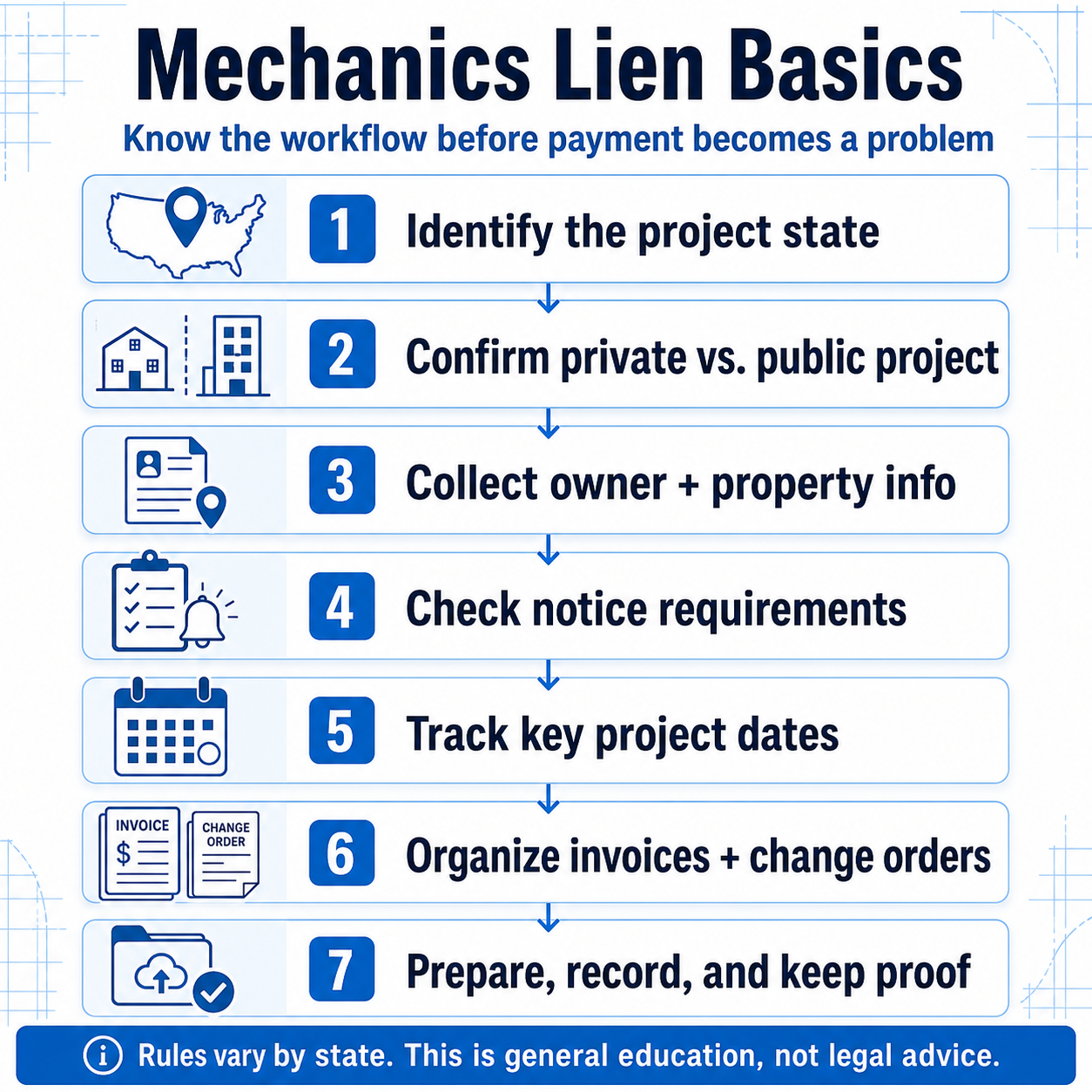
The better approach is to understand the basic payment-rights workflow before the problem starts:
- Know the state where the project is located.
- Know whether the project is public or private.
- Know who hired you.
- Know who owns the property.
- Keep your invoices and change orders organized.
- Track important project dates.
- Save notice and mailing records.
- Understand whether early notices may be required.
- Get legal review when the situation is deadline-sensitive or disputed.
You do not need to become a lawyer to run a better construction office.
But you do need to understand that lien rights are part of the business side of construction.
How StreamLien fits in
StreamLien helps contractors, subcontractors, suppliers, and construction teams prepare and organize construction payment documents from a structured project record.
The goal is not to make legal issues more complicated. The goal is to make the paperwork easier to manage before everything becomes urgent.
Mechanics liens, preliminary notices, releases, mailing records, and payment documents all work better when the project file is organized.
That is what StreamLien is built to support.
Bottom line
Mechanics liens matter because construction payment is different from ordinary collections.
If you work in construction, you should know what mechanics liens are, why state-specific rules matter, and why the project record should be organized before payment becomes a problem.
You may never want to file a lien.
But if you need one, you will be glad you understood the basics early.
Need help organizing construction payment documents? StreamLien helps contractors, subcontractors, and suppliers prepare construction payment documents online from a structured project record.
This article is for general educational purposes only and is not legal advice. Mechanics lien, preliminary notice, bond claim, stop payment notice, and construction payment rules are state-specific, deadline-sensitive, and fact-specific. Have legal/compliance language reviewed before relying on it.
FAQ
Is a mechanics lien the same in every state?
No. Mechanics lien rights are state-specific. The rules can vary by project type, claimant role, deadlines, notice requirements, recording requirements, and enforcement procedures.
Is it “mechanics lien” or “mechanic’s lien”?
You may see both. Different writers, courts, statutes, and states use slightly different wording. The practical point is to identify the correct document and rule for the state and project involved.
Is a mechanics lien the same as a preliminary notice?
No. A preliminary notice is generally an earlier notice document. A mechanics lien is generally a later payment-rights claim tied to the property or project. The exact relationship between the two depends on state law and project facts.
Do mechanics liens apply to public projects?
Public projects often involve different payment remedies, such as bond claims or stop payment notice procedures. The rules depend on the state and project type.
Does filing a mechanics lien guarantee payment?
No. A mechanics lien may be a powerful payment tool, but it does not guarantee payment, lien rights, compliance, or any legal outcome.
Related resources
August 24, 2026
Disputed Construction Payment Application? Records to Save Before Escalating
When a construction payment application is disputed, reduced, or delayed, organize the contract, pay app, backup, notices, change orders, emails, waivers, and deadline records before escalating.
August 23, 2026
Lien Waiver and Release Records to Check Before a Construction Payment Dispute
Before escalating a construction payment dispute, organize lien waivers, releases, payment status, project dates, and notice records so your next step is based on facts—not guesswork.
August 22, 2026
Late Construction Payments and Payroll Risk: Records Subcontractors Should Organize
Late construction payments can become payroll risk. Organize contracts, invoices, pay apps, notices, waivers, change orders, and deadlines before escalating.