
Mechanics Liens · General · 10 min read
By StreamLien · Published August 14, 2026 · Updated August 14, 2026
The Mechanics Lien Process: From Project File to Release
A mechanics lien is not a single form you think about after payment is late. It is a workflow that starts with the project record and ends with release, enforcement, or closeout.
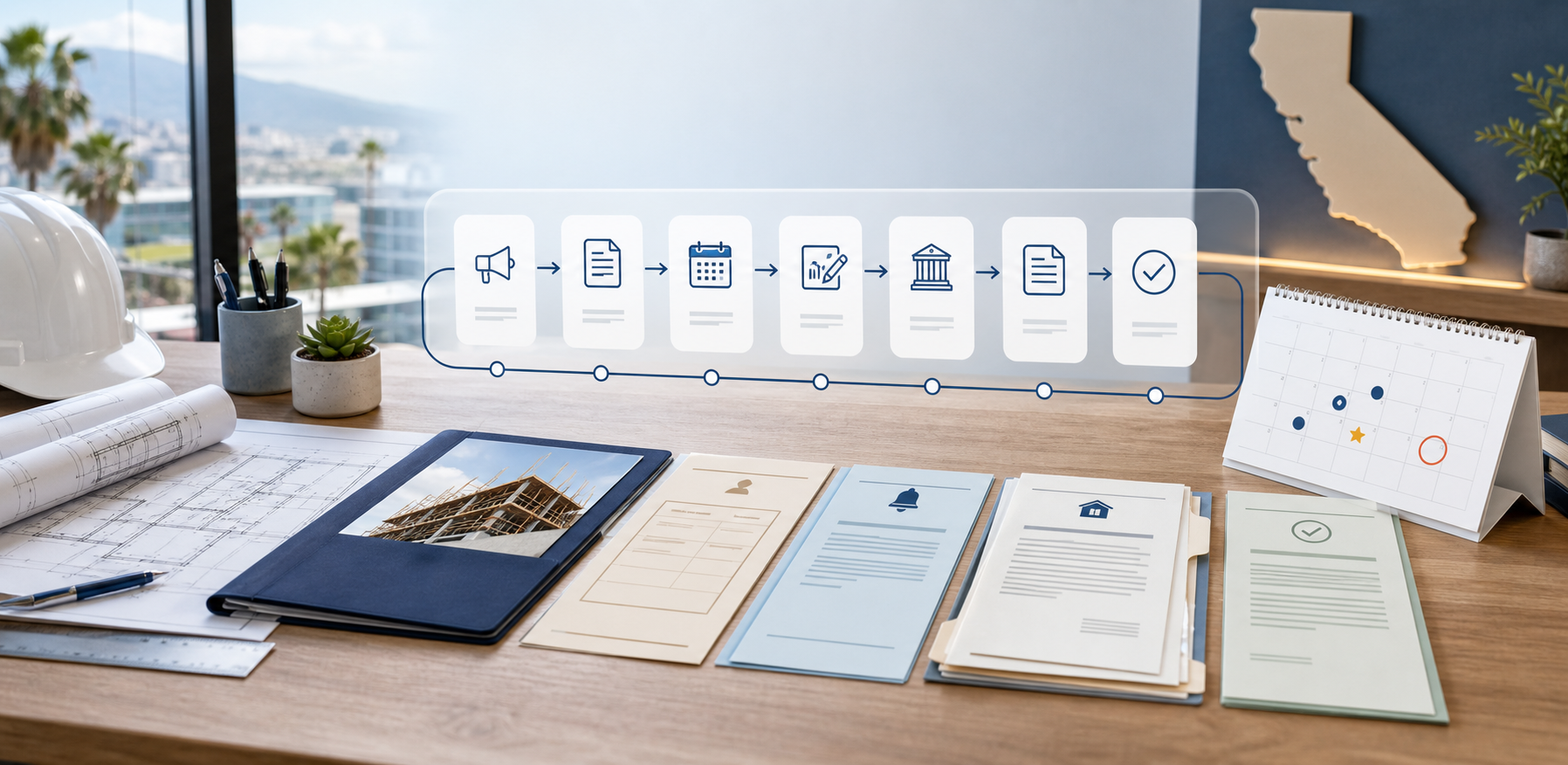
If you work in construction, a mechanics lien can feel like an emergency document.
The invoice is unpaid. The customer is not responding. The project is over, or close to over. Someone on the team says, “Can we file a lien?”
That is usually when the mechanics lien process becomes stressful.
But the lien itself is only one piece of a larger payment-rights workflow. The process usually starts much earlier, with the project file, the parties, the notices, the dates, the invoices, and the proof documents your team keeps along the way.
This article walks through the mechanics lien process at a high level. It is written for contractors, subcontractors, suppliers, and construction office managers who want to understand the workflow before payment becomes a problem.
Mechanics lien rules are state-specific and deadline-sensitive. Some states use different names, different notices, different recording rules, and different enforcement steps. Treat this as a practical overview, not legal advice.
Step 1: Set up the project file
The lien process begins before anyone uses the word “lien.”
A strong project file makes every later step easier. At the start of the job, your team should try to collect and organize the basic project information that may matter if payment slows down later.
That can include:
- the project name;
- the project address;
- the owner’s name;
- the general contractor or direct contractor;
- the party who hired you;
- your contract, proposal, quote, or purchase order;
- the scope of work, labor, equipment, or materials;
- first furnishing or first work information;
- invoices, payment applications, and change orders;
- notice documents and mailing proof;
- communications about payment, scope, and disputes.
If the project file is scattered across email, text messages, accounting software, and someone’s desk, the lien workflow gets harder.
A mechanics lien may be prepared later, but the facts usually come from records created throughout the project.
Step 2: Know the project state
Mechanics lien rights are controlled by state law.
That means the first question is not just “Can we lien this job?” It is also “What state is the project in?”
A contractor working in California should not assume the same process applies in Nevada, Arizona, Texas, Oregon, or any other state. The names, deadlines, required notices, forms, recording offices, service requirements, enforcement rules, and release rules can vary.
Even the terminology can change. Depending on the state and context, people may refer to mechanics liens, mechanic’s liens, construction liens, materialman’s liens, notices of furnishing, preliminary notices, stop payment notices, bond claims, or other payment documents.
Those are not all the same thing. The correct workflow depends on the state, the project type, and the claimant’s role.
Step 3: Confirm whether the project is private or public
Mechanics liens are commonly associated with private real property.
Public projects can involve different payment remedies, such as bond claims or stop payment notice procedures, depending on the state and project.
This distinction matters. A subcontractor who worked on a privately owned commercial building may be in a different workflow than a supplier on a public school project or a public infrastructure job.
Before choosing a document path, your team should identify whether the project is private, public, or something more complicated.
That early classification helps avoid treating every unpaid construction invoice the same way.
Step 4: Check required notices
Many lien problems start because the team thinks about notices too late.
Some states require early notices before lien rights can be preserved. Some use preliminary notices. Some use notices of furnishing. Some rules depend on whether you contracted directly with the owner, worked as a subcontractor, supplied materials, or performed another role.
The details vary by state, and this article does not try to state the rule for every situation.
The practical point is simple: notice questions belong near the beginning of the project, not only after an invoice becomes overdue.
Your project file should make it easy to answer questions like:
- Was a preliminary notice or similar notice needed?
- Was it prepared?
- Who received it?
- How was it delivered?
- Do we have proof of mailing, service, or delivery?
- Does the notice match the project and parties?
If those answers are unclear, the lien process becomes more difficult.
Step 5: Track key project dates
Dates matter in lien workflows.
Depending on the state and project, the relevant dates may include first work, first furnishing, last work, completion, notice dates, recording dates, service dates, payment dates, and release dates.
A construction office should avoid trying to reconstruct every date from memory after payment breaks down.
Instead, track important dates while the job is active. Save records that support those dates, such as work tickets, delivery records, invoices, daily reports, emails, photos, or project-management entries.
The more reliable the project timeline, the easier it is to evaluate next steps.
Step 6: Watch payment status before it becomes a crisis
A mechanics lien is often discussed after payment is already late.
But the better workflow is to monitor payment status before the file becomes urgent.
Your team should know:
- what has been billed;
- what has been paid;
- what remains unpaid;
- whether change orders are approved, pending, or disputed;
- whether retainage is being held;
- whether partial payments were made;
- whether the customer has objected to the work or amount.
This matters because a lien package often depends on the amount claimed, the work performed, the parties involved, and the supporting documents.
If the unpaid amount is unclear, the lien process becomes harder and riskier.
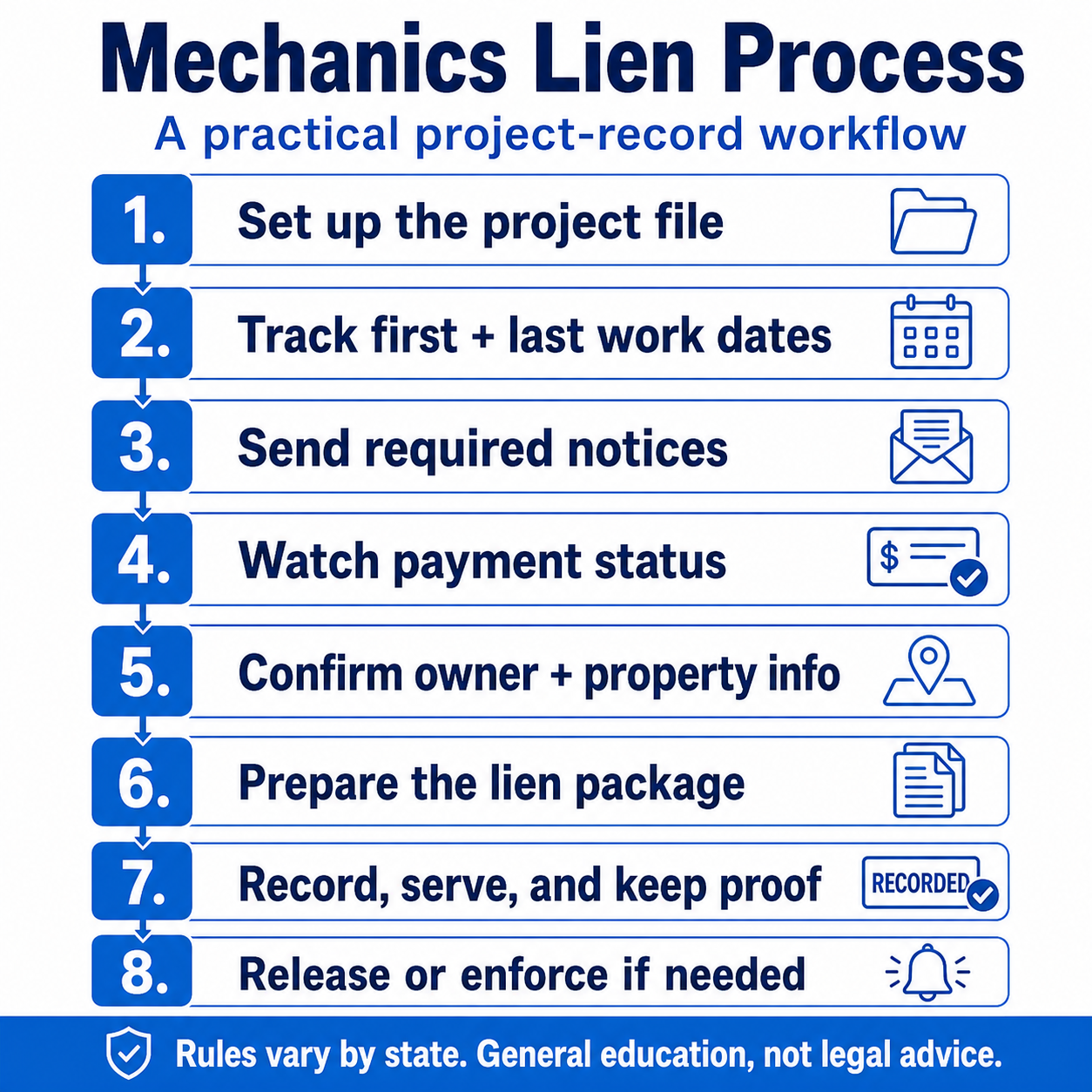
Step 7: Confirm owner and property information
A mechanics lien is connected to real property, so property information matters.
Before a lien package is prepared, the team often needs to confirm the project location, property owner information, and other project-party details. Depending on the jurisdiction and project, the legal property description, parcel information, owner name, direct contractor information, and other details may matter.
This is another reason the project file should be built early.
If your team does not know who owns the property, who hired whom, or what property was improved, the mechanics lien process can slow down quickly.
Step 8: Prepare the lien package
The lien document should not be treated as a generic form pulled together at the last minute.
A lien package may require careful information about the claimant, the property, the work or materials, the amount claimed, the hiring party, the project, and required notices or proof.
The exact requirements vary by state.
The practical workflow is to gather the information, check it against the project file, and avoid guessing.
Before a lien is prepared, your team should be able to locate:
- the claimant’s correct legal or business name;
- the project address and property information;
- the owner and contractor information available to the team;
- contract and scope records;
- invoices and payment history;
- change orders and dispute notes;
- notice records and proof documents;
- date records supporting the project timeline.
A clean file does not guarantee lien rights or payment, but it helps the team prepare more carefully.
Step 9: Record, serve, and keep proof
In many workflows, preparing the lien document is not the final step.
The lien may need to be recorded, filed, served, mailed, or otherwise handled under state-specific rules. Proof matters.
That means your team should not only ask, “Was the lien prepared?”
It should also ask:
- Was it recorded or filed in the correct place?
- Was it served or mailed if required?
- Who received it?
- How was it delivered?
- Do we have recording confirmation, mailing receipts, or service proof?
- Is the proof saved with the project file?
A document that cannot be connected to proof can create avoidable uncertainty later.
Step 10: Understand what happens after recording
A mechanics lien is not something to forget about after it is recorded.
After recording, there may be additional steps, deadlines, negotiations, disputes, payment discussions, release obligations, or enforcement decisions.
A lien may expire if the next required step is not taken. It may need to be released after payment. It may be challenged. It may require legal review.
This is where contractors should be careful.
Software can help organize the workflow and prepare documents, but it does not replace legal judgment in a disputed, deadline-sensitive, or high-value payment situation.
Step 11: Release or close out the lien when appropriate
The lien process should also include closeout.
If payment is made, a release may be needed. If a payment agreement is reached, the file should reflect what was agreed, what was paid, what was released, and what documents were exchanged.
Your closeout file may include:
- payment confirmation;
- lien release documents;
- lien waiver documents, if used;
- proof of recording or filing;
- correspondence confirming resolution;
- internal notes about what remains unpaid, if anything.
Do not treat the lien workflow as finished just because the pressure went down. A clean closeout record can matter later.
Where StreamLien fits in
StreamLien is built around the idea that construction payment documents work better when the project record is organized.
The mechanics lien process is not just a form. It is a workflow involving project information, notices, dates, invoices, property details, proof documents, and closeout records.
StreamLien helps contractors, subcontractors, suppliers, and construction teams organize project information and prepare construction payment documents from a structured record.
That does not guarantee payment, lien rights, compliance, or any legal outcome. But it does help reduce the last-minute scramble that happens when the project file is incomplete.
Bottom line
The mechanics lien process starts earlier than most contractors think.
It starts with the project file. It continues through notices, dates, invoices, property information, lien preparation, recording or service proof, and closeout.
If your team waits until payment is already overdue, you may still have options, but you may also be forced to answer important questions under pressure.
A better approach is to build the record while the project is active.
Need help organizing construction payment documents? StreamLien helps contractors, subcontractors, and suppliers prepare construction payment documents online from a structured project record.
This article is for general educational purposes only and is not legal advice. Mechanics lien, preliminary notice, bond claim, stop payment notice, lien release, and construction payment rules are state-specific, deadline-sensitive, and fact-specific. Have legal/compliance language reviewed before relying on it.
FAQ
When does the mechanics lien process start?
Practically, it starts when the project file is created. The lien document may come later, but the information needed for the lien often comes from notices, dates, invoices, contracts, and project records created throughout the job.
Is the mechanics lien process the same in every state?
No. Mechanics lien rules are state-specific. Different states may use different names, deadlines, notice requirements, recording procedures, service rules, enforcement steps, and release requirements.
Is a mechanics lien only for private projects?
Mechanics liens are commonly tied to private real property. Public projects may involve different remedies, such as bond claims or stop payment notice procedures, depending on the state and project.
What documents should I collect before preparing a lien?
A lien workflow often depends on the project address, owner information, hiring party, scope records, invoices, change orders, payment history, date records, notices, and proof of mailing or service. Exact requirements vary by state.
Does StreamLien guarantee lien rights or payment?
No. StreamLien does not guarantee lien rights, payment, compliance, or legal outcomes. It helps organize project information and prepare construction payment documents from a structured workflow.
Related resources
August 24, 2026
Disputed Construction Payment Application? Records to Save Before Escalating
When a construction payment application is disputed, reduced, or delayed, organize the contract, pay app, backup, notices, change orders, emails, waivers, and deadline records before escalating.
August 23, 2026
Lien Waiver and Release Records to Check Before a Construction Payment Dispute
Before escalating a construction payment dispute, organize lien waivers, releases, payment status, project dates, and notice records so your next step is based on facts—not guesswork.
August 22, 2026
Late Construction Payments and Payroll Risk: Records Subcontractors Should Organize
Late construction payments can become payroll risk. Organize contracts, invoices, pay apps, notices, waivers, change orders, and deadlines before escalating.