
Construction Payment · General · 10 min read
By StreamLien · Published July 7, 2026 · Updated August 14, 2026
Construction Payment Rights: Contractors, Subs, and Suppliers Have More Protection Than They Realize
Contractors, subcontractors, and material suppliers often have construction payment rights, but those rights can be missed, misunderstood, or handled incorrectly without a clear process.
Construction businesses do real work before they get fully paid.
A contractor may front labor, supervision, equipment, and overhead. A subcontractor may finish a major scope before the next progress payment arrives. A material supplier may deliver thousands of dollars of materials to a jobsite long before the final check clears.
That is one reason construction payment law is different from ordinary collections.
Contractors, subcontractors, and material suppliers often have rights connected to the project, the property, the payment chain, or a bond. Those rights can be powerful. But they are also easy to miss, easy to misunderstand, and easy to handle incorrectly if the project file is not organized.
The problem is not always that construction businesses have no rights.
The problem is often that they do not know what rights may exist, they think about them too late, or they do not have a process for managing the documents, dates, notices, and proof that those rights may depend on.
That is exactly the kind of workflow StreamLien is built to help manage.
This article is a general overview. Construction payment rights are state-specific, deadline-sensitive, and fact-specific. This is not legal advice.
Construction payment is not ordinary collections
When a regular business invoice goes unpaid, the dispute usually starts and ends with the customer who owes the money.
Construction is different.
A project may involve an owner, general contractor, multiple subcontractors, lower-tier subcontractors, suppliers, equipment providers, design professionals, lenders, sureties, and public entities. Money moves through a chain. The party who benefited from the work may not be the party who directly hired every person or company on the job.
That is why many states provide special construction payment remedies. Depending on the project and jurisdiction, those remedies may include notices, mechanics liens, construction liens, stop payment notices, bond claims, lien waivers, lien releases, payment claims, or other documents.
The names vary. The rules vary. The deadlines vary.
But the practical lesson is the same: construction payment rights are a workflow, not a last-minute form.
Contractors, subcontractors, and suppliers may have different rights
Your rights often depend on your role.
A general contractor may have a direct relationship with the owner. A subcontractor may have a contract with the general contractor. A material supplier may have sold materials to a subcontractor or directly to the project. A lower-tier subcontractor may be even farther down the chain.
Those differences can matter.
They may affect:
- what notices are required;
- who must receive documents;
- what project information should be collected;
- which payment remedy may apply;
- whether a bond claim, lien, stop payment notice, or other process is involved;
- what proof should be saved;
- what happens after payment is made.
A subcontractor should not assume the owner knows who it is. A supplier should not assume delivery tickets are enough. A contractor should not assume payment rights can be reconstructed later from memory.
The process starts with knowing your role and building the project file around it.
Many construction businesses do not know what rights they may have
A lot of construction businesses learn about payment-rights documents only after something goes wrong.
They hear about preliminary notices from another contractor. They hear about mechanics liens after a customer stops paying. They hear about bond claims after discovering the job is public. They hear about releases and waivers when someone asks them to sign one before payment has cleared.
That is backwards.
Construction businesses should understand the basic payment-rights landscape before the project becomes a dispute. They do not need to become lawyers, but they do need to know that payment documents are part of running a construction business.
If the team does not know that a right or process exists, it may miss the window to use it correctly.
Rights can be lost or weakened by poor process
Payment rights are not just about whether the law provides a remedy. They are also about whether the business can support the remedy with the right information and proof.
Problems often start with simple gaps:
- the project address is incomplete;
- the owner information is unclear;
- the hiring party is not identified correctly;
- first work or delivery dates are not tracked;
- notices were not sent or cannot be proven;
- invoices and change orders are scattered;
- payment records do not match the amount being claimed;
- the wrong document is used for the project type;
- releases or waivers are signed without a clean closeout file.
These are process problems.
They may become legal problems later, but they usually begin as office workflow problems.
State-specific rules make the process harder
Construction payment rights are not the same everywhere.
One state may use one term. Another state may use a different term. One state may require an early notice. Another may have a different notice system. One project may involve a mechanics lien. Another may involve a bond claim or stop payment notice. One document may need to be mailed, another recorded, another released, and another saved as proof.
That is why internet research can be dangerous if it is not tied to the correct state and project type. A contractor reading a general article may find a rule that applies somewhere else.
StreamLien content should keep this clear: the big-picture workflow can be understood generally, but the specific requirements must be checked for the state, project, role, and facts involved.
The project file is the foundation
The best time to manage construction payment rights is at the beginning of the project.
A strong project file should help answer the questions that come up later:
- What is the project?
- Where is the property?
- Who owns it?
- Who hired us?
- What did we agree to provide?
- When did we start?
- What did we deliver or perform?
- What has been billed?
- What has been paid?
- What is still unpaid?
- Were required notices sent?
- Do we have proof?
- What documents were signed at closeout?
A project file does not need to be complicated. But it does need to be organized enough that the business is not guessing when payment slows down.
Notices, liens, bond claims, and releases are connected
Construction payment documents should not be treated as unrelated paperwork.
They often connect to one another. An early notice may support later payment rights. A lien may depend on project and amount information. A bond claim may require a different path on a public project. A waiver or release may affect what happens after payment. Proof of mailing, service, recording, or delivery may matter if the document is questioned later.
The right document depends on the project.
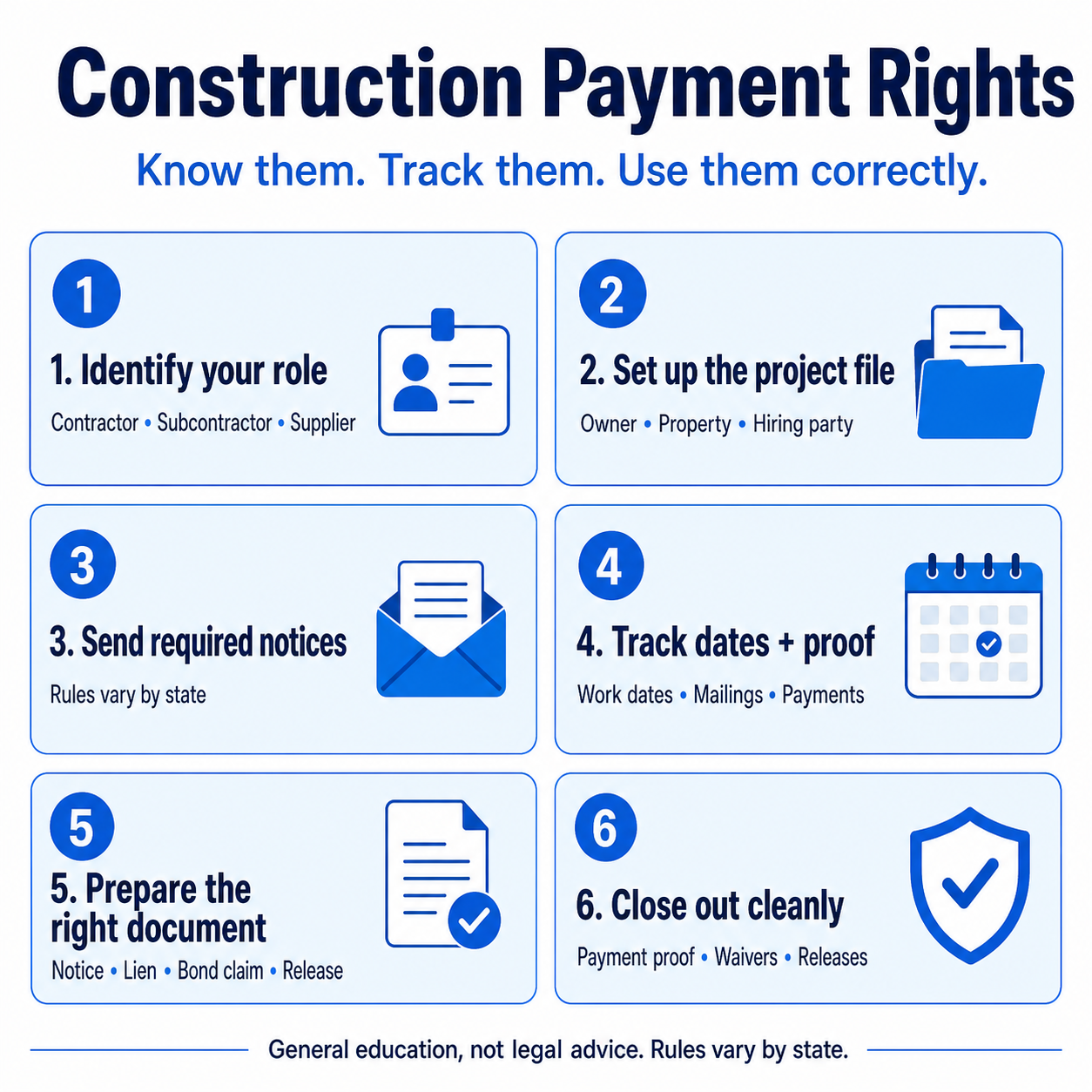
But the process usually depends on the same core habits:
- identify the project and parties;
- track the dates;
- send required notices;
- keep proof;
- organize billing records;
- choose the right document for the situation;
- close out the file cleanly.
Waiting until nonpayment is risky
Many contractors wait until an invoice is overdue before thinking about payment rights.
That is understandable. Nobody wants to spend time on paperwork when the project appears to be going smoothly. But waiting can create pressure.
By the time payment is late, the team may be trying to reconstruct dates, identify the owner, locate notices, confirm the unpaid amount, and figure out what document applies. That is a bad time to discover the file is incomplete.
A better approach is to manage the project record while the job is active.
The goal is not to be aggressive. The goal is to be prepared.
Suppliers need a process too
Material suppliers are often overlooked in construction payment workflows.
A supplier may not visit the jobsite often. It may not have a direct relationship with the owner. It may rely on purchase orders, delivery tickets, account statements, and communications with the party who ordered materials.
Those records can be critical.
Suppliers should have a process for connecting deliveries to the correct project, tracking who ordered the materials, saving delivery proof, monitoring invoices, and understanding whether notices or other payment documents may be needed.
A supplier’s rights may depend on details that are easy to lose if the project is treated like a normal sales account.
Subcontractors need more than invoices
Subcontractors often assume that if they did the work and sent the invoice, the payment file is good enough.
But a stronger file usually includes more than invoices.
It may include the subcontract, scope records, change orders, daily reports, work dates, notices, correspondence, payment applications, retention records, and proof documents.
If payment is disputed, the subcontractor may need to show what was performed, when it was performed, who hired it, what remains unpaid, and what notices or payment documents were handled.
That is a workflow problem StreamLien can help organize.
Contractors need clean closeout too
General contractors and direct contractors also need payment-document discipline.
They may need to manage notices from downstream parties, owner payment issues, subcontractor payment records, releases, waivers, project closeout documents, and proof that payment documents were handled correctly.
A contractor who only focuses on getting paid may miss the importance of clean closeout.
Payment proof, waivers, releases, and final records matter because construction payment rights do not disappear from the file just because a check arrived.
How StreamLien helps manage the process
StreamLien helps turn construction payment rights into a manageable workflow.
Instead of waiting until the invoice is overdue and then trying to rebuild the file, StreamLien is designed around structured project information and document preparation.
That means the business can focus on the key questions:
- What role are we in?
- What project is this?
- Who are the parties?
- What dates matter?
- What notices or documents may be needed?
- What proof should be saved?
- What has to happen at closeout?
StreamLien does not guarantee payment, lien rights, compliance, or legal outcomes. It does not replace legal review when a matter is disputed, deadline-sensitive, or high-value.
But it does help construction businesses avoid treating payment rights as a panic-button document.
The better approach is a process.
Bottom line
Contractors, subcontractors, and material suppliers often have construction payment rights that are easy to overlook or mishandle.
Those rights may involve notices, mechanics liens, bond claims, stop payment notices, waivers, releases, deadlines, proof, and state-specific rules.
The specific rules vary, but the business lesson is practical: build the project file early, track the right information, and manage payment documents as a workflow.
If your team waits until payment is already late, you may still have options, but you may also be forced to solve avoidable problems under pressure.
Need a better way to manage construction payment documents? StreamLien helps contractors, subcontractors, and suppliers organize project information and prepare construction payment documents online from a structured workflow.
This article is for general educational purposes only and is not legal advice. Construction payment rights, notices, liens, bond claims, stop payment notices, waivers, releases, deadlines, and service requirements are state-specific, deadline-sensitive, and fact-specific. Have legal/compliance language reviewed before relying on it.
FAQ
Do contractors, subcontractors, and suppliers all have the same payment rights?
No. Payment rights may depend on the state, project type, contract chain, role, documents, notices, and facts. Contractors, subcontractors, and material suppliers should not assume the same workflow applies to everyone.
Why do construction payment rights get missed?
They are often missed because businesses think about them too late, do not know which documents may apply, fail to track dates, or do not keep proof of notices, mailings, deliveries, invoices, or releases.
Are mechanics liens the only construction payment right?
No. Mechanics liens are one important tool, but construction payment workflows may also involve notices, bond claims, stop payment notices, lien waivers, releases, and other documents depending on the state and project.
Can StreamLien tell me whether I have legal rights?
StreamLien helps organize project information and prepare construction payment documents. It does not guarantee rights, compliance, payment, or legal outcomes. Legal review may be needed for disputed or deadline-sensitive matters.
What is the first step in managing construction payment rights?
Start with the project file. Identify the role, project, property, owner, hiring party, scope, dates, invoices, notices, proof, and closeout records so the team is not guessing later.
Related resources
August 24, 2026
Disputed Construction Payment Application? Records to Save Before Escalating
When a construction payment application is disputed, reduced, or delayed, organize the contract, pay app, backup, notices, change orders, emails, waivers, and deadline records before escalating.
August 23, 2026
Lien Waiver and Release Records to Check Before a Construction Payment Dispute
Before escalating a construction payment dispute, organize lien waivers, releases, payment status, project dates, and notice records so your next step is based on facts—not guesswork.
August 22, 2026
Late Construction Payments and Payroll Risk: Records Subcontractors Should Organize
Late construction payments can become payroll risk. Organize contracts, invoices, pay apps, notices, waivers, change orders, and deadlines before escalating.