
Preliminary Notices · California · 10 min read
By StreamLien · Published August 7, 2026 · Updated August 27, 2026
California 20-Day Preliminary Notice Checklist for Subcontractors and Suppliers
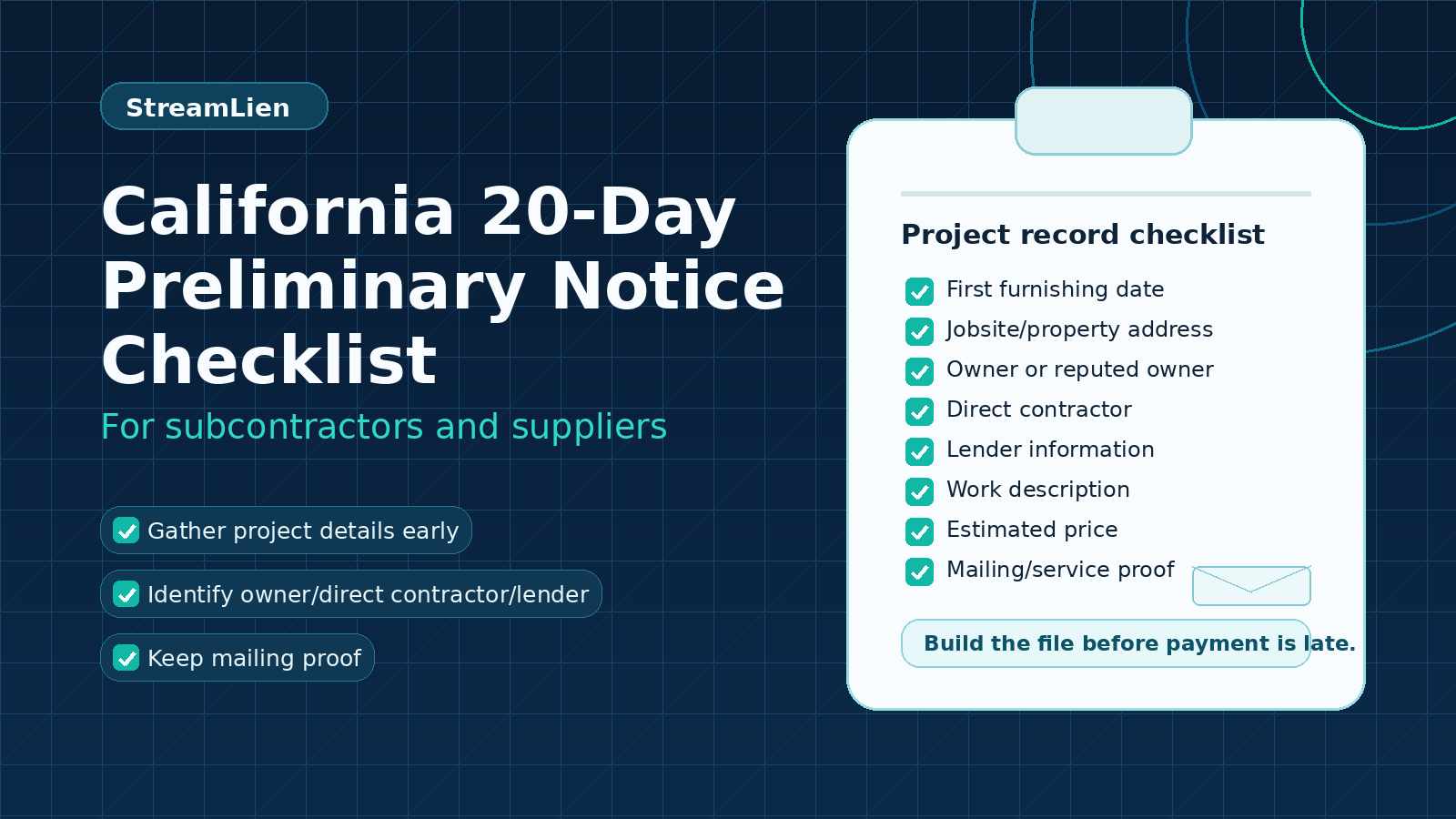
Use this practical California 20-day preliminary notice checklist to gather project details, identify key parties, track mailing records, and avoid waiting until payment problems start.
Most construction payment problems do not start when an invoice becomes overdue.
They often start earlier — when the project record is incomplete, the right parties are not identified, or the preliminary notice workflow is handled too late.
For California subcontractors, material suppliers, equipment rental companies, and construction office teams, the 20-day preliminary notice is one of the most important documents to get organized early. It is not just a form. It is part of the payment-rights workflow.
This checklist is designed to help you gather the information commonly needed before preparing a California 20-day preliminary notice.
- This article is for general educational purposes only and is not legal advice. California construction notice and lien rules can be deadline-sensitive and fact-specific.
What is a California 20-day preliminary notice?
A California 20-day preliminary notice is a construction project notice commonly used by subcontractors, suppliers, and other project participants to help preserve certain payment remedies.
In plain English, it tells key project parties that your company is providing labor, materials, equipment, or services to the project.
The notice is often part of the early project paperwork that supports later payment-rights steps if there is a dispute or nonpayment problem.
California Civil Code sections 8200 and 8204 are important statutory references for preliminary notice timing, recipients, and effect.
The “20-day” mistake: do not use the deadline as a reason to wait
One common mistake is treating “20-day preliminary notice” as if it means:
- “I have 20 days, so I can deal with this later.”
That can create problems.
The safer business workflow is to gather the project information as soon as you start supplying labor, materials, equipment, or services. Waiting until an invoice is stale, a project contact goes quiet, or payment is already late can make it harder to identify the owner, direct contractor, lender, jobsite address, or mailing records.
The goal is simple:
- Build the project record early, before there is a payment problem.
What is the 20-day deadline?
California’s 20-day preliminary notice timing rules are tied to when work, labor, services, equipment, or materials are first furnished to the project. Civil Code § 8204 is the key statutory timing reference.
Because deadline calculations, project roles, late notices, and exceptions can be fact-specific, this article should not be treated as a final legal deadline guide.
For workflow purposes, contractors and suppliers should generally avoid waiting until the end of any deadline period. The best practical habit is to collect the required project information at the beginning of the job and prepare the notice workflow early.
What happens if you send a preliminary notice late?
A late preliminary notice may still have value in some circumstances, but the effect of a late notice depends on the applicable law and project facts.
That means businesses should not assume that “late” means “worthless” — and they should not assume that a late notice fully protects them either.
The practical takeaway:
- If the notice may be late, do not ignore it. Get the information organized, review the timing, and evaluate the potential effect.
California 20-day preliminary notice checklist
Before preparing a California 20-day preliminary notice, gather the information below.
1. First furnishing date
Identify the first date your company provided labor, materials, equipment, or services to the project.
This date is important because preliminary notice timing is often measured from the start of your work or supply activity.
Keep this date in your project file, along with supporting records such as:
- Delivery tickets
- Work orders
- Time records
- Rental logs
- Purchase orders
- Job start emails
- Invoices
- Dispatch records
2. Your company information
Make sure the notice uses consistent claimant information.
Gather:
- Legal business name
- DBA, if applicable
- Business address
- Phone number
- Email address
- License number, if applicable
- Contact person for the project
- Role on the project, such as subcontractor, supplier, or equipment rental company
This helps avoid confusion later if payment records, contracts, invoices, and notice documents need to be matched.
3. Jobsite or property address
Get the most complete property description available.
Start with:
- Street address
- City
- County
- Project name
- Lot or unit number, if applicable
- Any other identifying project information
If the jobsite address is incomplete, inconsistent, or hard to confirm, flag it early. Do not wait until payment is overdue to figure out where the project legally sits.
4. Owner or reputed owner
Identify the owner or reputed owner of the property.
This information may come from:
- The contract
- The purchase order
- Project documents
- Direct contractor information
- Public records
- Project intake forms
- Communications from the customer
Keep owner or reputed owner information in your project file so the notice workflow starts with the best available party information.
5. Direct contractor
Identify the direct contractor or prime contractor on the project.
For many subcontractors and suppliers, the customer may not be the owner. Your project file should show who hired you and who is above that party in the project chain.
Gather:
- Direct contractor name
- Mailing address
- Contact person
- Contract or PO reference
- Project email thread
- Any customer-provided project information
6. Lender, if any
If project documents identify a construction lender, include that information in your project file.
Gather:
- Lender name
- Mailing address
- Loan or project reference, if available
- Source document showing lender information
Do not guess. If lender information is unavailable, note that it was not provided and keep working to complete the project record.
7. Description of work, materials, services, or equipment
Write a short, plain-English description of what your company is providing.
Examples:
- Electrical materials supplied for tenant improvement project
- HVAC labor and equipment
- Concrete materials
- Equipment rental for site work
- Framing labor
- Plumbing supplies
Keep it clear and consistent with your invoices, contract, purchase order, and delivery records.
8. Estimated price or contract amount
Gather the estimated price, contract amount, purchase order amount, or expected value of the work or materials.
Depending on the project, this may come from:
- Signed contract
- Purchase order
- Quote
- Change order
- Rental agreement
- Supplier invoice history
If the number may change, keep your internal project file updated.
9. Service and mailing records
Preliminary notice is not only about preparing the document. Proof of mailing or service records can become just as important later.
Keep a file with:
- Date sent
- Method of mailing or service
- Recipient names
- Recipient addresses
- Copies of the notice
- Certified mail records, if used
- Tracking numbers
- Delivery confirmations or returned mail records
- Internal notes showing who prepared and sent the notice
Keep mailing and service records organized so they are easy to find if payment questions arise later.
10. Internal project record
Create one central project file for notice-related documents.
Include:
- Contract or purchase order
- Change orders
- Invoices
- Delivery tickets
- Work logs
- Project correspondence
- Preliminary notice copy
- Mailing/service records
- Payment history
- Contact list for owner, direct contractor, lender, and customer
This makes it easier to respond quickly if payment slows down later.
Quick preliminary notice intake checklist
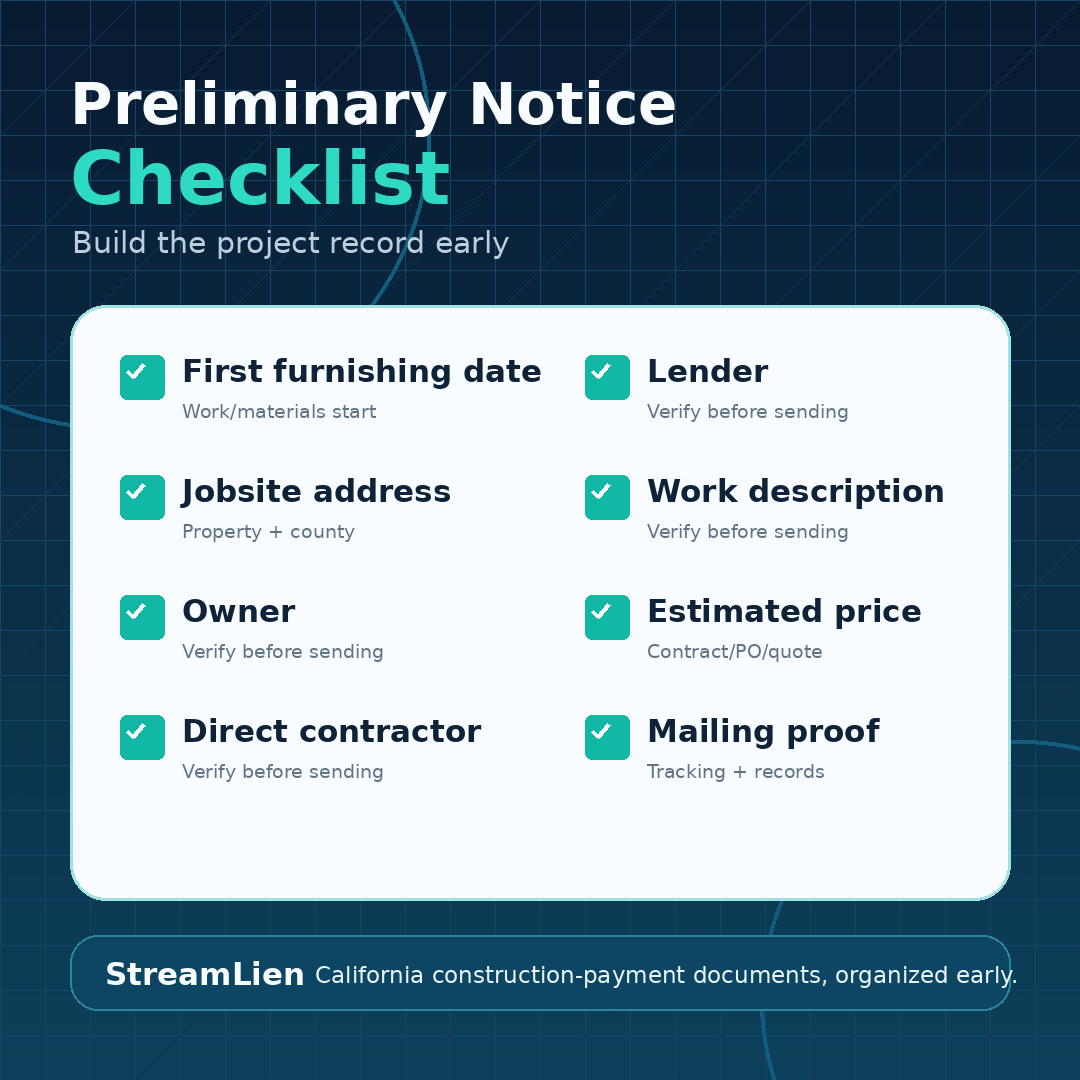
Use this short checklist when opening a new California project:
- Project name
- Jobsite/property address
- County
- First furnishing date
- Your company’s role
- Customer name and address
- Direct contractor name and address
- Owner or reputed owner name and address
- Lender information, if any
- Description of work/materials/equipment
- Estimated price or contract amount
- Contract, PO, quote, or rental agreement
- Delivery tickets or work-start records
- Notice preparation date
- Mailing/service date
- Mailing/service proof
- Tracking numbers or certified mail records
- Copy of final notice sent
Why preliminary notice workflow matters before payment is late
By the time an invoice is overdue, your team may already be under pressure.
The project manager wants payment. The office is looking for contact information. The customer may be slow to respond. The jobsite may have changed. The owner information may be unclear. The paperwork may be scattered across email, invoices, delivery tickets, and text messages.
A better workflow is to organize preliminary notice information at the beginning of the job.
That way, if payment becomes a problem later, your business is not starting from scratch.
How StreamLien helps organize the preliminary notice workflow
StreamLien is designed to make California preliminary notice preparation easier for busy construction businesses.
Instead of waiting until an invoice is stale, StreamLien helps you organize the key project details needed for the notice workflow, including party information, project details, work descriptions, and mailing/service records.
StreamLien is a practical workflow tool for contractors, subcontractors, suppliers, and construction office teams that want to build better project records early.
It does not guarantee payment, lien rights, legal compliance, or any legal outcome. But it can help make the notice-preparation process more organized and easier to manage.
Bottom line
The California 20-day preliminary notice should not be treated as last-minute paperwork.
For subcontractors and suppliers, it is part of the early project setup process.
The best habit is simple:
- Gather the project information early. Identify the key parties. Track the first furnishing date. Keep proof of mailing or service records. Do not wait until the invoice is overdue to build the file.
FAQ: California 20-Day Preliminary Notice
What is a California 20-day preliminary notice?
A California 20-day preliminary notice is a construction notice commonly used to inform key project parties that a company is providing labor, materials, equipment, or services to a project. It is often part of the workflow for preserving certain payment remedies.
Who should use a California preliminary notice checklist?
Subcontractors, material suppliers, equipment rental companies, and construction office teams can use a checklist to gather project details early, including the first furnishing date, owner information, direct contractor information, lender information if available, work description, estimated price, and mailing records.
When should I start gathering preliminary notice information?
As early as possible — ideally when the project is opened or when your company first starts furnishing labor, materials, equipment, or services. The practical mistake is waiting until an invoice is overdue before trying to identify the owner, direct contractor, lender, or jobsite information.
What information do I need for a California 20-day preliminary notice?
Common project information includes your company information, first furnishing date, jobsite/property address, owner or reputed owner, direct contractor, lender if any, description of work or materials, estimated price, and proof of mailing or service records.
What happens if a preliminary notice is sent late?
A late preliminary notice may still have value in some circumstances, but its effect depends on the applicable law and project facts. Do not assume it is useless, and do not assume it fully protects you. Have late-notice timing and coverage issues reviewed.
Does StreamLien guarantee compliance or payment?
No. StreamLien helps organize and prepare California preliminary notice workflows, but it does not guarantee legal compliance, lien rights, payment, or any legal outcome.
Is this legal advice?
No. This article is for general educational purposes only and is not legal advice. California construction notice and lien rules can be deadline-sensitive and fact-specific.
Prepare your California preliminary notice workflow before payment becomes a problem
StreamLien helps subcontractors, suppliers, and construction office teams organize project details, prepare preliminary notice information, and keep better records — without waiting until invoices go stale.
Start your California preliminary notice with StreamLien.
Related resources
August 24, 2026
Disputed Construction Payment Application? Records to Save Before Escalating
When a construction payment application is disputed, reduced, or delayed, organize the contract, pay app, backup, notices, change orders, emails, waivers, and deadline records before escalating.
August 23, 2026
Lien Waiver and Release Records to Check Before a Construction Payment Dispute
Before escalating a construction payment dispute, organize lien waivers, releases, payment status, project dates, and notice records so your next step is based on facts—not guesswork.
August 22, 2026
Late Construction Payments and Payroll Risk: Records Subcontractors Should Organize
Late construction payments can become payroll risk. Organize contracts, invoices, pay apps, notices, waivers, change orders, and deadlines before escalating.