
Mechanics Liens · California · 5 min read
By StreamLien · Published July 8, 2026 · Updated August 14, 2026
California Mechanics Lien Deadlines: The Map Contractors Should Build Before Recording
California mechanics lien deadlines depend on claimant role, project completion, recorded notices, and post-recording enforcement. Build the date map before you record.
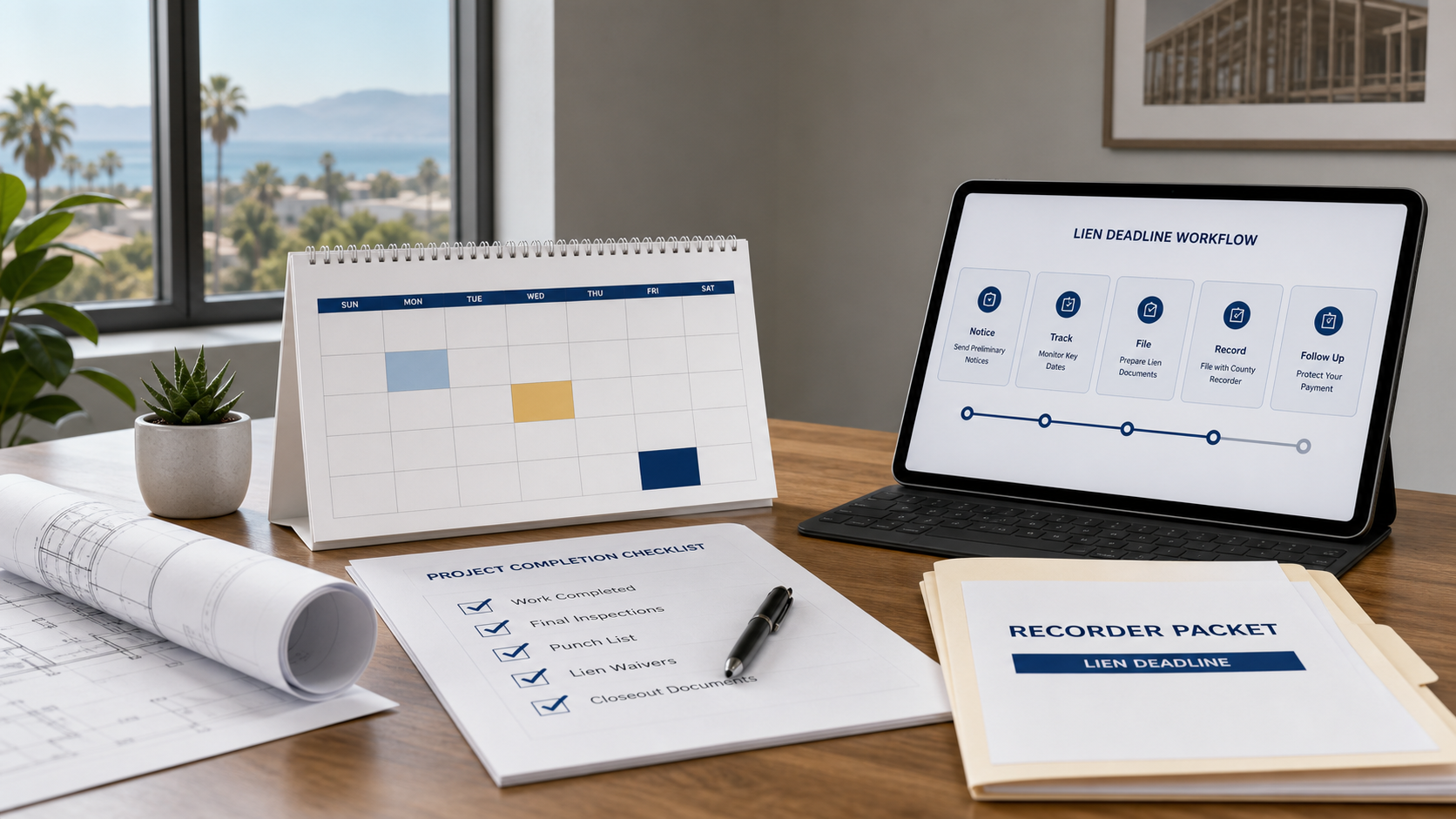
California mechanics lien deadlines are not one date. They are a sequence of dates that depend on who the claimant is, when work started, when the claimant stopped work, when the overall project was completed, whether the owner recorded a notice, and what happens after the lien is recorded.
That is why a mechanics lien workflow should not start with a blank form. It should start with a deadline map.
For contractors, subcontractors, suppliers, and equipment lessors, the practical question is not just “can we record a lien?” It is: “What facts control the first day we can record, the last day we can record, and the next deadline after recording?”
The first date is usually the first work date
The first work date matters because it drives preliminary notice analysis. Many California lien claimants must give a preliminary notice not later than 20 days after first furnishing labor, services, equipment, or materials.
A late preliminary notice may still have value, but it can limit the protected work. That means the first work date should be captured early, not reconstructed after invoices are overdue.
StreamLien’s workflow approach treats the first work date as a project-file fact. It belongs with the owner, direct contractor, lender, property, hiring-party, and work-description information.
Preliminary notice is part of the lien timeline
A mechanics lien is not isolated from preliminary notice compliance. For many non-owner-direct claimants, preliminary notice is what preserves the ability to later record a lien for the full protected scope of work.
The research materials emphasize that claimant role matters. A direct contractor, subcontractor, lower-tier subcontractor, supplier, equipment lessor, laborer, and design professional may have different notice questions. The recipient list can also matter: owner or reputed owner, direct contractor or reputed direct contractor, and construction lender or reputed construction lender.
The mistake is waiting until nonpayment to figure this out.
There is also an earliest recording date
A lien can be too early as well as too late.
For direct contractors, the recording analysis generally turns on completion of the direct contract. For other claimants, the analysis generally turns on whether the claimant has ceased providing work. The attached checklist flags punch-list, corrective, warranty, callback, inspection, cleanup, delivery, and demobilization facts because they can affect the “ceased work” analysis.
That is an easy issue to miss in a purely form-based process. If a claimant records before it is legally allowed to record, the lien can become vulnerable.
Completion of the overall project controls the outside window
California private-work lien deadlines are tied to completion of the work of improvement. The research materials identify several completion concepts, including actual completion, occupation or use accompanied by cessation of labor, continuous cessation of labor, and notices of cessation after a qualifying work stoppage.
The practical point: do not rely on a single completion date supplied casually by the client or project team. The completion date should be tied to evidence.
Evidence may include project communications, final work records, owner use or occupancy facts, cessation records, recorded notices of completion or cessation, and county recorder data.
Recorded notices can shorten the recording window
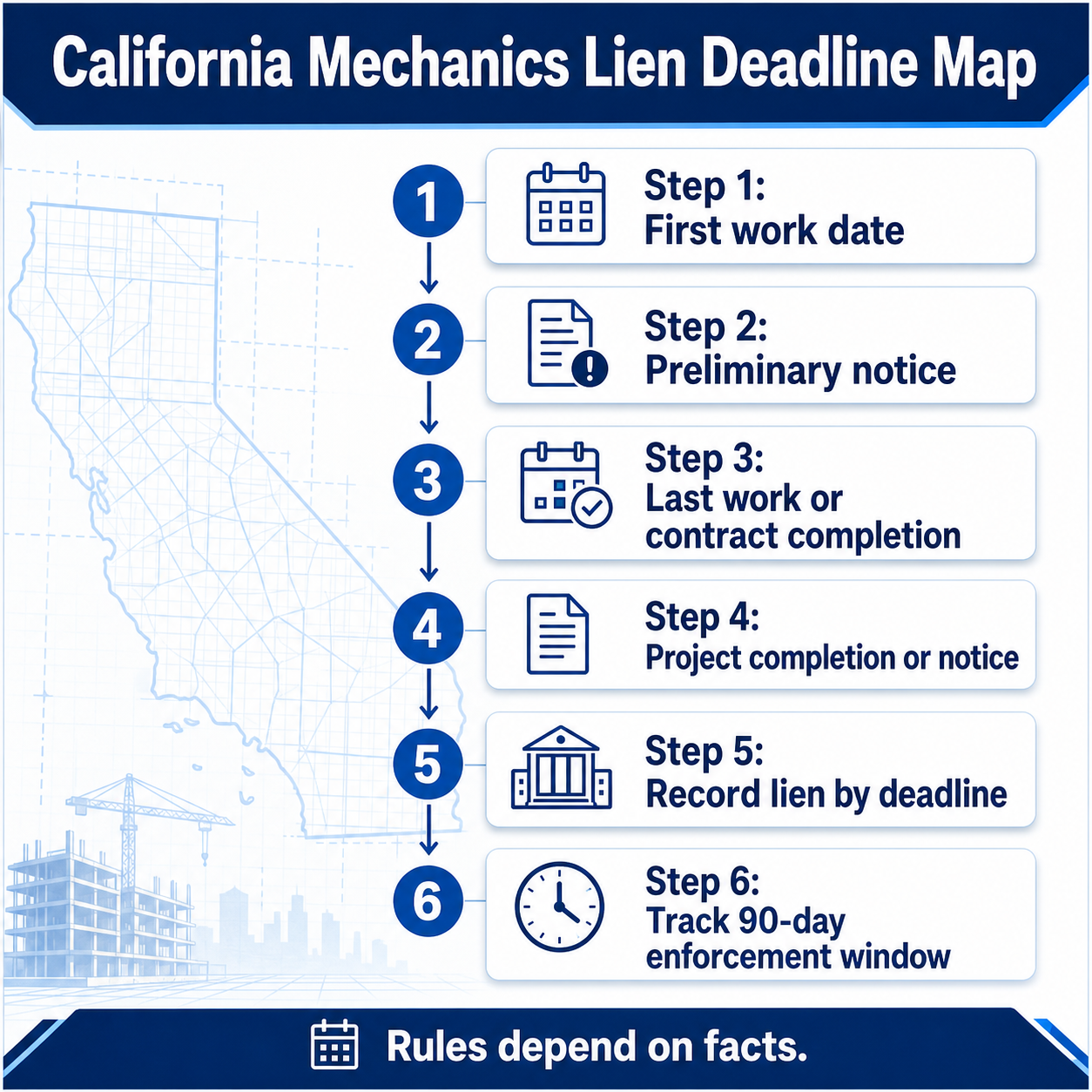
If no valid notice of completion or cessation controls, the outside lien recording period is commonly discussed as 90 days after completion of the work of improvement.
But a recorded notice can shorten that timeline. The research materials distinguish the 60-day window for direct contractors from the 30-day window for other claimants when a valid notice of completion or cessation is recorded.
Even then, the analysis may not be global. The owner’s service of a recorded notice can matter. For nonexempt owners, failure to timely serve a required direct contractor or preliminary-notice claimant may make the notice ineffective to shorten that person’s deadline.
The last day is not the only date to calendar
A good lien workflow should calendar more than the final deadline. It should track:
- first furnishing of work;
- preliminary notice deadline;
- claimant’s last regular contract work;
- direct-contract completion or claimant cessation;
- project completion events;
- notice of completion or cessation recordation;
- owner service of recorded notice, if required;
- internal target recording date;
- actual recorder submission and acceptance;
- recorded instrument number; and
- 90-day post-recording enforcement deadline.
Recording is not the end of the process. A California mechanics lien must be controlled after recording because the lien can expire if enforcement is not timely handled.
StreamLien helps turn lien timing into a managed process
The risk is not that contractors are unaware that deadlines exist. The risk is that the deadline depends on facts spread across contracts, invoices, preliminary notices, project communications, county records, owner notices, and mailing records.
StreamLien is built around the idea that construction payment rights are a workflow. The project file, notice records, deadline assumptions, lien documents, service proof, and post-recording calendar should be organized together.
That does not guarantee payment or legal compliance. But it helps busy construction businesses stop treating lien rights as a last-minute form and start treating them as a managed process.
FAQ
What is the biggest California mechanics lien deadline mistake?
One common mistake is looking only at the unpaid invoice date. Lien deadlines usually depend on project and work-completion facts, recorded notices, claimant role, and post-recording enforcement timing.
Does a notice of completion always shorten the deadline?
Not always. The notice must be valid and, in some situations, must be timely served on the required people before it shortens a particular claimant’s deadline.
Can a lien be recorded too early?
Yes. The research materials flag the need to determine the earliest lawful recording date based on the claimant’s role and whether the claimant has completed or ceased the relevant work.
Does recording a lien create payment automatically?
No. Recording is one step. The lien must also be tracked after recording, including the 90-day enforcement window.
Suggested CTA
Before you record a California mechanics lien, build the deadline map. StreamLien helps organize project facts, notice records, lien documents, service proof, and deadline tracking so the process is easier to manage from first work through post-recording follow-up.
Related resources
August 24, 2026
Disputed Construction Payment Application? Records to Save Before Escalating
When a construction payment application is disputed, reduced, or delayed, organize the contract, pay app, backup, notices, change orders, emails, waivers, and deadline records before escalating.
August 23, 2026
Lien Waiver and Release Records to Check Before a Construction Payment Dispute
Before escalating a construction payment dispute, organize lien waivers, releases, payment status, project dates, and notice records so your next step is based on facts—not guesswork.
August 22, 2026
Late Construction Payments and Payroll Risk: Records Subcontractors Should Organize
Late construction payments can become payroll risk. Organize contracts, invoices, pay apps, notices, waivers, change orders, and deadlines before escalating.